
Retinol, Retinoic Acid and Tretinoin: How They Actually Work in the Skin
Retinoids have earned their place in skincare. They have been studied for decades and can help with concerns ranging from acne to fine lines and sun damage.1,2 But the names can get confusing, and somewhere along the way, people have started treating skincare strength as a competition.
You don’t need the strongest product available. You need something that suits your skin and that you can use consistently without your face becoming sore, red and uncomfortable.
First, let’s clear up the names
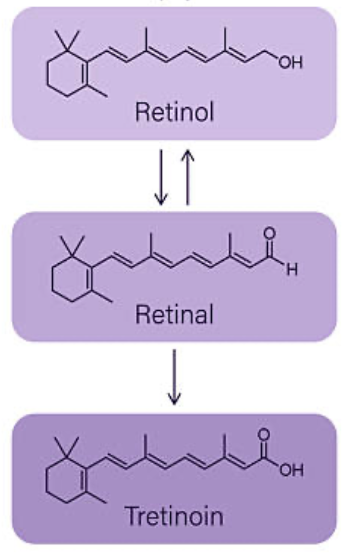
Retinoid is the umbrella term for a family of vitamin A compounds. Retinol, retinal and tretinoin all belong to that family, but they aren’t interchangeable.
Retinol needs to go through two conversion steps in the skin. It becomes retinal, also called retinaldehyde, which then becomes retinoic acid. Retinal starts one step further along that pathway.2
Tretinoin is retinoic acid. It is already in the form that binds directly to retinoic acid receptors, so it doesn’t need those conversion steps.2 That helps explain its activity, but concentration and formulation also affect how a product performs and how well your skin tolerates it. You can’t compare percentages across different retinoids as though they mean the same thing.
What are they actually doing?
Retinoids influence how skin cells behave. They help normalise the shedding of cells inside pores, which is part of why topical retinoids are used to treat acne.3 Certain retinoids can also improve uneven pigmentation and support collagen production while reducing some of the processes involved in collagen breakdown.1,2,4 These changes take time.
This is more than simply exfoliating the surface. The aim isn’t to peel your skin until something fresher appears underneath.
It’s also worth separating topical retinoids from oral isotretinoin. They belong to the same broader family, but you shouldn’t expect a retinol serum to suppress oil production in the way an oral acne medicine can.5
Peeling is not the goal
Some dryness, mild redness or flaking can happen when you first introduce a retinoid.3 Using too much, applying it too frequently or combining it with other irritating products can make that worse.
But irritation isn’t proof that your skincare is working. You don’t need to push through burning, persistent redness or painful skin to earn a result. Significant irritation is a reason to pause and seek advice, particularly if you develop swelling, blistering or crusting.
The same goes for “purging”. Acne can temporarily worsen when starting some retinoids, but that doesn’t mean every new breakout or rash is a purge. If your skin keeps getting worse, the routine needs reviewing rather than blindly continuing.
Give your skin time
For someone new to a cosmetic retinoid, a gradual introduction can help with tolerance. That might mean starting on one or two nights a week and increasing slowly. Prescription treatment should follow the instructions given by your prescriber.
For many facial retinoid creams, a pea-sized amount is enough for the whole face. Applying more won’t speed up the results. Apply to dry skin, keep it away from the eyelids and corners of the nose and mouth unless specifically directed, and use moisturiser to support comfort.
I would also keep the rest of the routine simple while you settle in. Starting a retinoid, an exfoliating toner and a strong acid serum together makes it much harder to work out what your skin can tolerate.
Daily sun protection belongs in the routine too.6 Retinoids don’t replace sunscreen, and irritated skin needs particular care in the sun. Think in months rather than days when assessing changes in skin quality.
Do you need a prescription?
Not everyone needs to progress from retinol to a prescription product. There isn’t a skincare ladder you are supposed to climb.
Whether a prescription retinoid is appropriate depends on the concern being treated, your skin, your medical history and what else you’re using. Tretinoin acts directly on the same retinoic acid pathway that retinol reaches after conversion. Being active from the outset doesn’t automatically make it the best choice for everyone.
Retinoids should be avoided during pregnancy or when planning pregnancy. If you are breastfeeding, discuss the specific product with your treating clinician before using it.
My approach is to find a routine your skin can live with. If you’re constantly stopping because your face is irritated, we need to adjust something. Consistency matters far more than being able to say you use the strongest product.
References
1. Mukherjee S, Date A, Patravale V, et al. Retinoids in the treatment of skin aging: an overview of clinical efficacy and safety. Clin Interv Aging. 2006;1(4):327–48. doi:10.2147/ciia.2006.1.4.327
2. Zasada M, Budzisz E. Retinoids: active molecules influencing skin structure formation in cosmetic and dermatological treatments. Postepy Dermatol Alergol. 2019;36(4):392–7. doi:10.5114/ada.2019.87443
3. Leyden J, Stein-Gold L, Weiss J. Why topical retinoids are mainstay of therapy for acne. Dermatol Ther (Heidelb). 2017;7(3):293–304. doi:10.1007/s13555-017-0185-2 Funded by Galderma, which makes topical retinoids.
4. Kafi R, Kwak HS, Schumacher WE, et al. Improvement of naturally aged skin with vitamin A (retinol). Arch Dermatol. 2007;143(5):606–12. doi:10.1001/archderm.143.5.606
5. Layton A. The use of isotretinoin in acne. Dermatoendocrinol. 2009;1(3):162–9. doi:10.4161/derm.1.3.9364
6. Hughes MCB, Williams GM, Baker P, Green AC. Sunscreen and prevention of skin aging: a randomized trial. Ann Intern Med. 2013;158(11):781–90. doi:10.7326/0003-4819-158-11-201306040-00002
Written by Dr Brandon Kober-Brown MBBS, ProfDipMensHlth, GCCM
Registered Medical Practitioner (General Registration) MED0002581903
Disclaimer: This article provides general information and is not personal medical advice. Retinoids are not suitable for everyone. Prescription treatments require an individual medical assessment and should be used as directed by your treating practitioner.
