
Exfoliating Acids: AHAs, BHAs and What They Actually Do for Your Skin
Glycolic acid. Lactic acid. Salicylic acid. Mandelic acid. If you spend any time looking at skincare online, you’ve probably been told you need at least one of them.
Exfoliating acids can be useful, but choosing one starts with understanding what you’re trying to improve. Dullness, rough texture and blocked pores aren’t quite the same problem, and they don’t necessarily need the same approach.
You also don’t need to use every acid available. Your skin is unlikely to thank you for that.
AHAs work on surface texture
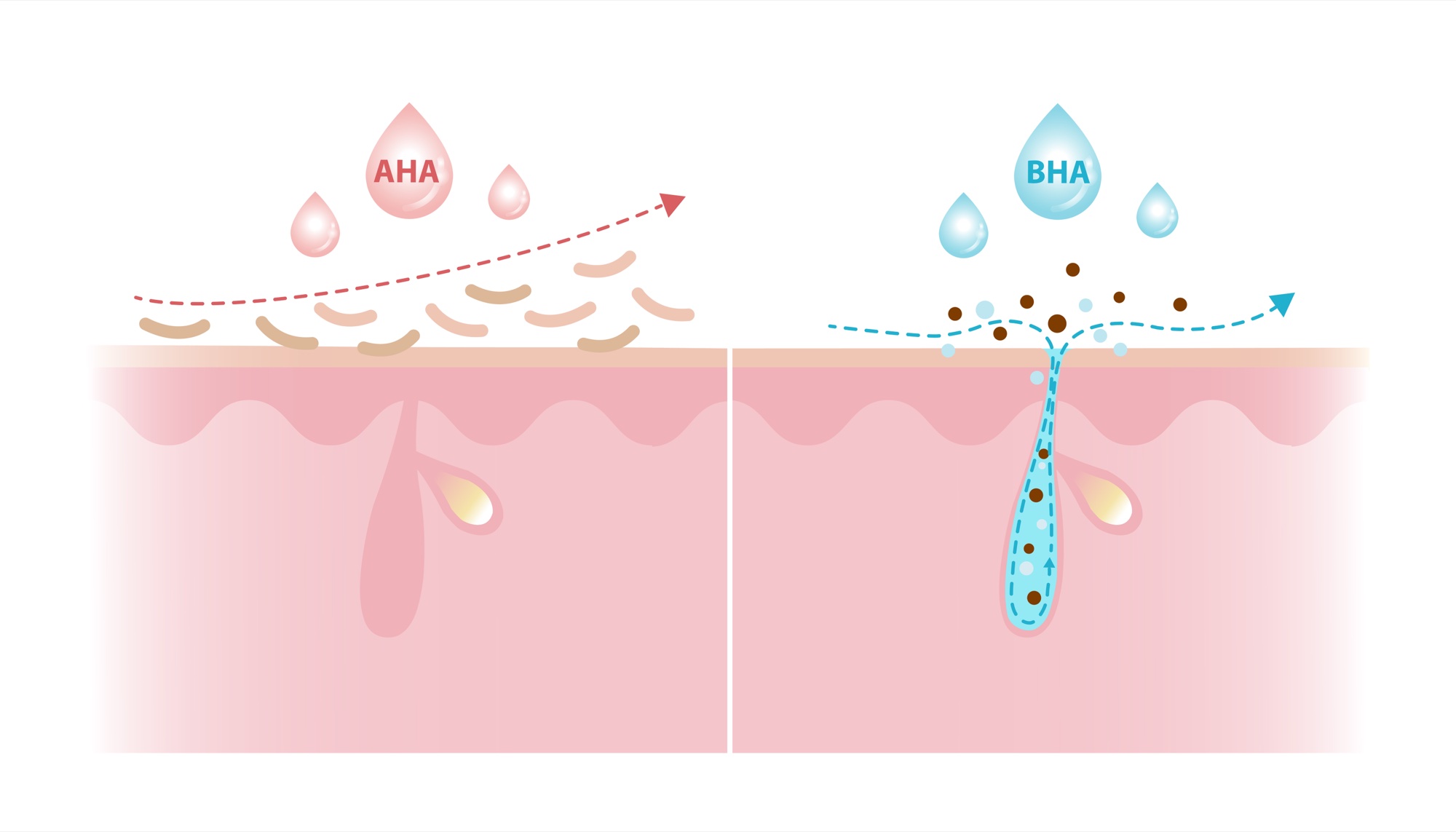
Alpha hydroxy acids, or AHAs, include glycolic, lactic and mandelic acid. They help loosen the connections between dead cells at the skin’s surface so those cells can shed more easily.1
That exfoliation can leave skin feeling smoother and looking brighter. How much exfoliation happens depends on the acid, its concentration, the product’s acidity and the rest of the formula.1,2 The percentage on the bottle only tells you part of the story.
This is why I wouldn’t choose a product simply because it has the highest number on the label. A stronger product isn’t automatically a better match for your skin.
And while AHAs can help with surface dullness, dry or flaky skin doesn’t automatically need exfoliating. Sometimes it needs a simpler routine and more support with hydration. Adding acid to already irritated skin can make things worse.
BHAs are useful for blocked pores
In skincare, BHA usually means salicylic acid. It is oil soluble, which makes it particularly useful for working within oily pores and helping loosen the build-up of cells that contributes to blockages.2,3
If blackheads and congestion are your main concerns, salicylic acid may be worth considering. It is an established option in acne care, particularly for blackheads and whiteheads.3 But it isn’t essential for everyone with breakouts, and persistent acne may need a different treatment plan.
I would be cautious about promises of “poreless” skin. Pores are a normal part of your skin. The aim is to manage congestion and improve how your skin looks and feels, rather than chase an appearance that only exists with a filter.
Can you use both?
You can, but the first question is whether you need to.
A product formulated with both AHAs and salicylic acid is different from layering several separate exfoliants and hoping for the best. Your cleanser, toner and serum might all contain exfoliating ingredients, so it’s worth looking at the whole routine before adding something new.
My approach is to introduce one product at a time, follow its directions and start conservatively. For a leave-on exfoliant, that may mean once a week initially. You can then assess whether your skin tolerates it and whether it is actually helping.
If you already use a retinoid, be especially cautious about adding acids. Using them on separate nights may help with tolerance, but it doesn’t guarantee that the combination will suit your skin.
When to step back
Your skin shouldn’t feel persistently tight, sore or stripped after skincare. Burning, ongoing redness or moisturiser suddenly stinging are reasons to pause the exfoliating products and review the routine.
Strong acids can cause irritation and chemical burns. More exfoliation can also lead to unwanted pigment changes, which rather defeats the purpose if you started using the product for a more even complexion.1,3
If you have active eczema, a rosacea flare, broken skin or are recovering from a procedure, get advice before introducing or restarting acids. Follow your treating practitioner’s aftercare instructions rather than deciding your skin looks ready.
Sun protection matters too. AHAs can increase sensitivity to UV, including for up to a week after stopping.2,4 Use sunscreen alongside shade and protective clothing. Applying your acid at night doesn’t remove that need.
Are they worth using?
For the right concern, yes. An exfoliating acid can be a useful addition for rough texture, dullness or congestion. But it should have a clear purpose in your routine.
If your skin is comfortable and you’re happy with it, you don’t need to add an acid because everyone else is using one. And if your routine is leaving you irritated, adding another active is unlikely to be the answer.
I would much rather you use one well-chosen product consistently than spend months alternating between over-exfoliating and trying to repair the irritation.
References
1. Tang SC, Yang JH. Dual effects of alpha-hydroxy acids on the skin. Molecules. 2018;23(4):863. doi:10.3390/molecules23040863
2. Kornhauser A, Coelho SG, Hearing VJ. Applications of hydroxy acids: classification, mechanisms, and photoactivity. Clin Cosmet Investig Dermatol. 2010;3:135–42. doi:10.2147/CCID.S9042
3. Arif T. Salicylic acid as a peeling agent: a comprehensive review. Clin Cosmet Investig Dermatol. 2015;8:455–61. doi:10.2147/CCID.S84765
4. Kaidbey K, Sutherland B, Bennett P, et al. Topical glycolic acid enhances photodamage by ultraviolet light. Photodermatol Photoimmunol Photomed. 2003;19(1):21–7. doi:10.1034/j.1600-0781.2003.00013.x
Written by Dr Brandon Kober-Brown MBBS, ProfDipMensHlth, GCCM
Registered Medical Practitioner (General Registration) MED0002581903
Disclaimer: This article is intended for general educational purposes only and should not be taken as personal medical advice. It is not a substitute for a consultation with a registered medical practitioner. Exfoliating products don’t suit every skin, and persistent irritation should be assessed by an appropriately qualified practitioner.
