

Sweating through your shirt in a Sydney summer
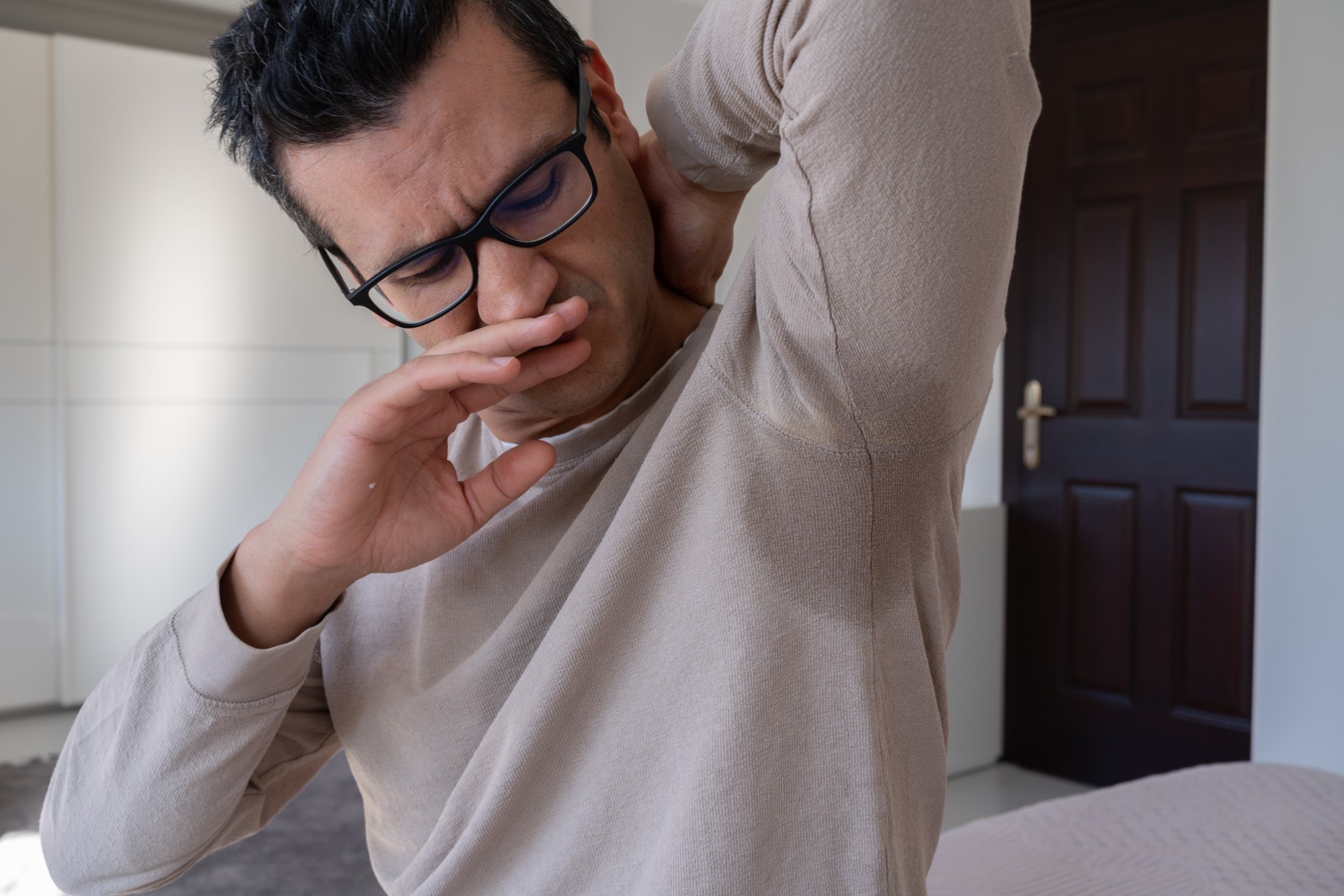
You've planned your wardrobe around it. Dark shirts only. A spare in the bag. Arms down in photos, a blazer in a meeting when it's 32 degrees outside, and a quiet calculation before every handshake.
If that's you, two things. It has a name, and it isn't a hygiene problem, a fitness problem or a character flaw. It's a medical condition called hyperhidrosis, about one in twenty people have it, and most of them have never mentioned it to a doctor.1
This is what it is, how to tell it apart from the kind you should get checked, and the order I'd work through the fixes, from the pharmacy to the clinic.
It has a name, and one in twenty people have it
Hyperhidrosis means sweating well beyond what your body needs to keep cool. The common kind, primary focal hyperhidrosis, hits specific spots: underarms, palms, soles, sometimes the face and scalp. It usually starts in the teens or early 20s, often runs in families, switches off while you sleep, and happens whether or not it's hot.2
The problem isn't your sweat glands. You have the same number as everyone else. The problem is the nerve signal that tells them to fire, which in hyperhidrosis is turned up far too high and responds to things that shouldn't trigger it: a mildly warm room, a meeting, a first date, the thought of sweating.
That last one matters. Anxiety doesn't cause hyperhidrosis, but it amplifies it, and the condition creates its own anxiety.3 Worrying about the patch makes the patch worse. Breaking that loop is half the treatment.
Why Sydney makes it so much worse
Sweat only cools you when it evaporates, and in a humid Sydney summer it doesn't. It sits on the skin, soaks the shirt and keeps coming. Add the daily cycle of a hot walk to the station, a freezing train, a hot walk to the office and air-conditioning that sets you off again on the way back out, and the glands never get a quiet hour.
Most people with hyperhidrosis in Sydney live by the same unspoken rules: no grey, no pale blue, no linen, no raised arms, no cold drink held against the shirt. December through March is survived rather than enjoyed. It doesn't have to be.
First, make sure it's the ordinary kind
Primary hyperhidrosis is a nuisance, not a danger. Secondary hyperhidrosis is sweating caused by something else, and that's worth finding. See your GP before anything cosmetic if:2
- it started suddenly, especially after 25
- it's all over rather than in specific spots
- you sweat heavily at night, through the sheets
- it came with weight loss, fever, a racing heart or new tiredness
- it began after starting a new medication
- you're a woman in your 40s or 50s (perimenopause is the most common cause I see, and it's treated differently)
None of those apply, it's been there since school, and it's in the usual places? It's almost certainly the primary kind, and it's treatable.
How to fix it, in order
Cheapest first. A surprising number of people stop at step one, because it turns out they'd been doing it wrong.
Use antiperspirant properly (most people don't)
Deodorant hides smell. Antiperspirant blocks sweat. Check the label: if it doesn't contain an aluminium salt, it isn't an antiperspirant.
Apply it at night, to completely dry skin, not in the morning after a shower. The aluminium needs hours in a dry sweat duct to form its plug, and morning application onto damp skin washes straight out.4
Step up to a clinical-strength product from the pharmacy (aluminium chloride 10 to 20%). Nightly for a week, then two or three times a week. It works on palms and feet too.
Stinging means it went onto damp or freshly shaved skin. Dry thoroughly, apply, and wash it off in the morning.
Dress for it
Merino and good cotton breathe and don't show patches the way synthetics do. Sweat-proof undershirts with a waterproof underarm panel are better than they sound. Patterns and black hide what grey shows. None of this treats anything, but it gives you your arms back while you work on the rest.
For hands and feet, try iontophoresis
For palms and soles, a home iontophoresis device passes a mild current through tap water into the skin. Twenty to thirty minutes, several times a week to start, then maintenance. It's slow and undramatic, and for a lot of people with sweaty hands, it's enough.4
If none of that is enough, there's a clinic option
If the underarms (or palms) are still soaking through after all of that, there's an in-clinic treatment for focal hyperhidrosis. It's prescription-only in Australia, which means the advertising rules stop me describing it here. Whether it's right for you is a consultation conversation, not an article one.
And beyond that
For severe cases there are oral medications (through your GP), a device-based treatment that permanently reduces the underarm glands, and, as a last resort, surgery on the nerve itself. I mention the surgery mainly to say that it commonly causes heavy sweating somewhere else instead, so it's rarely the right answer.4 A good doctor will refer you on if you need any of these.
Where a consultation comes in
This is the condition people are most relieved to say out loud, which is why the first conversation at CLEON is a complimentary telehealth consult. You can have it from your kitchen, in a t-shirt, with the air-con on. We work out whether it's the primary kind, which of these you've actually tried properly, and whether the in-clinic treatment makes sense for you.
If it does, the next step is a short appointment at the Potts Point clinic. If it doesn't, you leave with a proper antiperspirant technique and a plan, which is more than most people with this have ever been given.
You're not the sweaty guy
Nobody in the meeting thinks you're unhygienic. People with hyperhidrosis shower more than anyone, not less. What others think, if they notice at all, is that the room is warm.
The point of treating this isn't vanity. It's getting a Sydney summer back: a pale shirt, a raised arm, a handshake you don't have to think about. That's a reasonable thing to want, and it's a reasonable thing to fix.
Questions I get asked about this
Is it because I'm unfit or overweight?
No. Primary hyperhidrosis is about the nerve signal, not your fitness. Plenty of lean, fit people have it, and losing weight doesn't switch it off.
Is it anxiety?
Not the cause, but a reliable amplifier. The loop of worrying about sweating, then sweating, is real, and treating the sweat is often the fastest way to treat the worry.
My antiperspirant doesn't work.
Nine times out of ten it's being applied in the morning onto damp skin. Night, dry skin, clinical strength. Give that two weeks before deciding it's failed.
Will it go away as I get older?
It often eases after 40 or 50, but not reliably, and that's a long time to wait.
Can sweaty hands be treated too?
Yes. Iontophoresis first, then the same in-clinic conversation if that isn't enough.
Is it dangerous?
Primary hyperhidrosis, no. If any of the red flags above apply, see your GP first.
Hyperhidrosis treatment at Cleon →
References
1. Doolittle J, Walker P, Mills T, Thurston J. Hyperhidrosis: an update on prevalence and severity in the United States. Arch Dermatol Res. 2016;308(10):743–9. doi:10.1007/s00403-016-1697-9
2. Nawrocki S, Cha J. The etiology, diagnosis, and management of hyperhidrosis: a comprehensive review: etiology and clinical work-up. J Am Acad Dermatol. 2019;81(3):657–66. doi:10.1016/j.jaad.2018.12.071
3. Bahar R, Zhou P, Liu Y, et al. The prevalence of anxiety and depression in patients with or without hyperhidrosis (HH). J Am Acad Dermatol. 2016;75(6):1126–33. doi:10.1016/j.jaad.2016.07.001
4. Nawrocki S, Cha J. The etiology, diagnosis, and management of hyperhidrosis: a comprehensive review: therapeutic options. J Am Acad Dermatol. 2019;81(3):669–80. doi:10.1016/j.jaad.2018.11.066
Written by Dr Brandon Kober-Brown MBBS, ProfDipMensHlth, GCCM
Registered Medical Practitioner (General Registration) MED0002581903
Disclaimer: This article is intended for general educational purposes only and should not be taken as personal medical advice. It is not a substitute for a consultation with a registered medical practitioner. See your GP first if your sweating is new, all over your body, or comes with other symptoms.
