
Facial Aesthetics for Men: What’s Different About the Approach?
Male aesthetics has exploded over the past few years. And honestly? About time.
Men are becoming far more comfortable looking after their appearance, investing in their skin and addressing the things that bother them. Most simply want to look healthier, sharper, fresher or less tired, without pretending they have suddenly started drinking three litres of water a day.
But treating men aesthetically is not simply a matter of taking treatments designed for women and applying them to a male face.
Male facial anatomy is different. Men generally age differently, have different treatment goals and often approach cosmetic medicine with a completely different mindset. What looks balanced and natural on a female face can look noticeably “off” on a male face, even when the treatment has technically been performed well.
Understanding masculine facial structure is therefore incredibly important. Accidentally feminising a male face is one of the fastest ways to create a result that does not feel right.
Most men don’t want to look “done”
This is probably the biggest difference.
Most male patients are not coming into the clinic asking to look snatched, heavily contoured, completely wrinkle-free or perfectly smooth. They usually want to look less tired, healthier, sharper or slightly more defined. Most importantly, they still want to look like themselves and they still want to look masculine.
The goal is rarely to erase every line or remove all character from the face. In fact, many men suit some facial movement, texture, angularity and stronger proportions. A completely frozen or overly filled male face can start looking uncanny very quickly.
Ideally, the response should be, “You look good, mate. Have you lost weight or something?”
Not, “Why do you suddenly look like a filtered Instagram influencer?”
Male facial structure genuinely is different
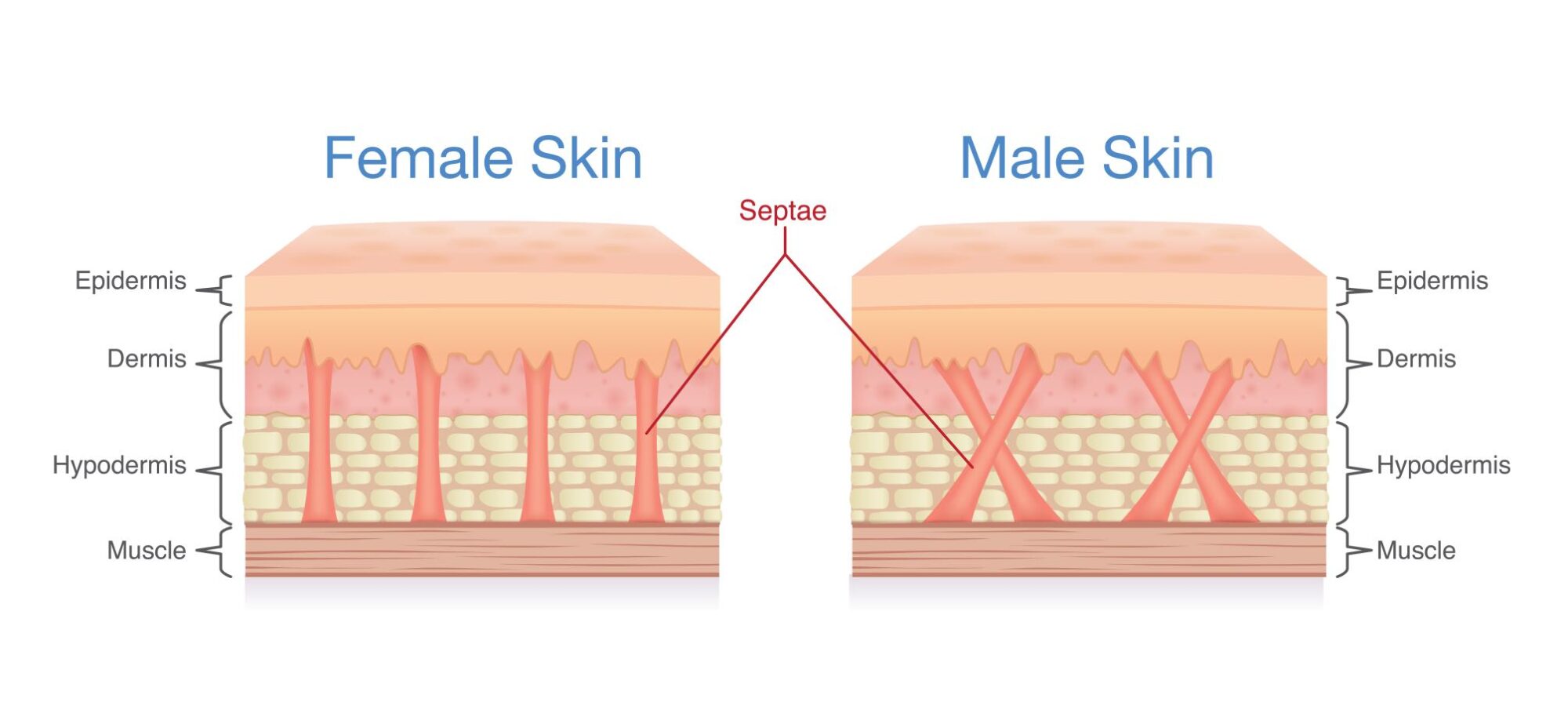
Generally speaking, men tend to have thicker skin, stronger facial muscles, larger facial skeletons, heavier brows and wider, more angular lower faces. Female faces are often characterised by softer contours, greater cheek prominence, narrower jaws and different brow positioning.
These are general patterns, not rigid rules. Every face still needs to be assessed individually. However, they matter enormously when planning treatment.
A technique that creates a beautiful result on a female face may unintentionally soften or feminise a male face if it is copied without considering the underlying proportions.
The male jawline is a perfect example. A strong jaw is commonly associated with masculinity and facial structure, but the internet has completely lost its mind over jawlines lately. Every second bloke suddenly wants one sharp enough to cut glass.
That is not always realistic, and it is not always attractive.
A good male jawline should look balanced, proportionate and natural from the front, profile and during movement. It should not look like someone has smuggled Lego blocks under the skin.
Masculine does not mean enormous filler volumes, cartoonishly square jaws, aggressively projected chins or unnatural sharpness. Once a face becomes overfilled, it often loses the definition the treatment was intended to create in the first place.
Puffy does not equal masculine.
Men often age differently
Men commonly experience heavier brow descent, hollowing around the eyes, facial volume loss, sun damage, redness and rougher skin texture. Forehead and frown lines can also become more pronounced because male facial muscles are often larger and stronger.
This means anti-wrinkle treatment needs to be planned differently. A dose that softens movement beautifully in one patient may do absolutely bugger all in another.
The aim is not automatically to freeze every muscle. It is to understand which movements are contributing to an angry, tired or stressed appearance and soften them without removing the character of the face.
Most male patients are also extremely conservative when they first attend. Some have spent years privately considering treatment before finally booking, and many are genuinely nervous about looking obvious. That concern is completely reasonable because poor male aesthetic work tends to announce itself very quickly.
This is why I would usually rather start conservatively, assess the result and build gradually if needed.
Skin quality is massively underrated in men
Many men initially focus on structure: the jawline, profile, wrinkles or definition. However, improving skin quality can create a far greater overall change than adding volume.
Sun damage, redness, enlarged pores, acne scarring, pigmentation, dehydration and rough texture can all make someone appear older or more tired. Depending on the patient, laser resurfacing, collagen-stimulating treatments, medical skincare or pigment management may provide a more meaningful improvement than filler.
Healthy skin changes the appearance of the entire face. It reflects light better, looks fresher and gives the impression that someone is healthier and better rested.
And importantly, it still looks masculine.
The psychology is different too
Many men are still navigating embarrassment, stigma or fear of judgement around cosmetic treatment. Some do not tell their friends or partners that they are attending a clinic.
That is why the environment matters. Men generally want honesty, practicality, realistic expectations, minimal fuss and discretion. They do not want an aggressive sales pitch or a ring light shoved in their face the second they walk through the door.
My role is to explain what is realistically achievable, what I think will make the greatest difference and, just as importantly, what I do not think they need.
Written by Dr Brandon Kober-Brown MBBS, ProfDipMensHlth, GCCM
Registered Medical Practitioner (General Registration) MED0002581903
Disclaimer: This article is intended for general educational purposes only and should not be taken as personal medical advice. It is not a substitute for a consultation with a registered medical practitioner. Treatment suitability varies between individuals and should be assessed by an appropriately qualified practitioner.
